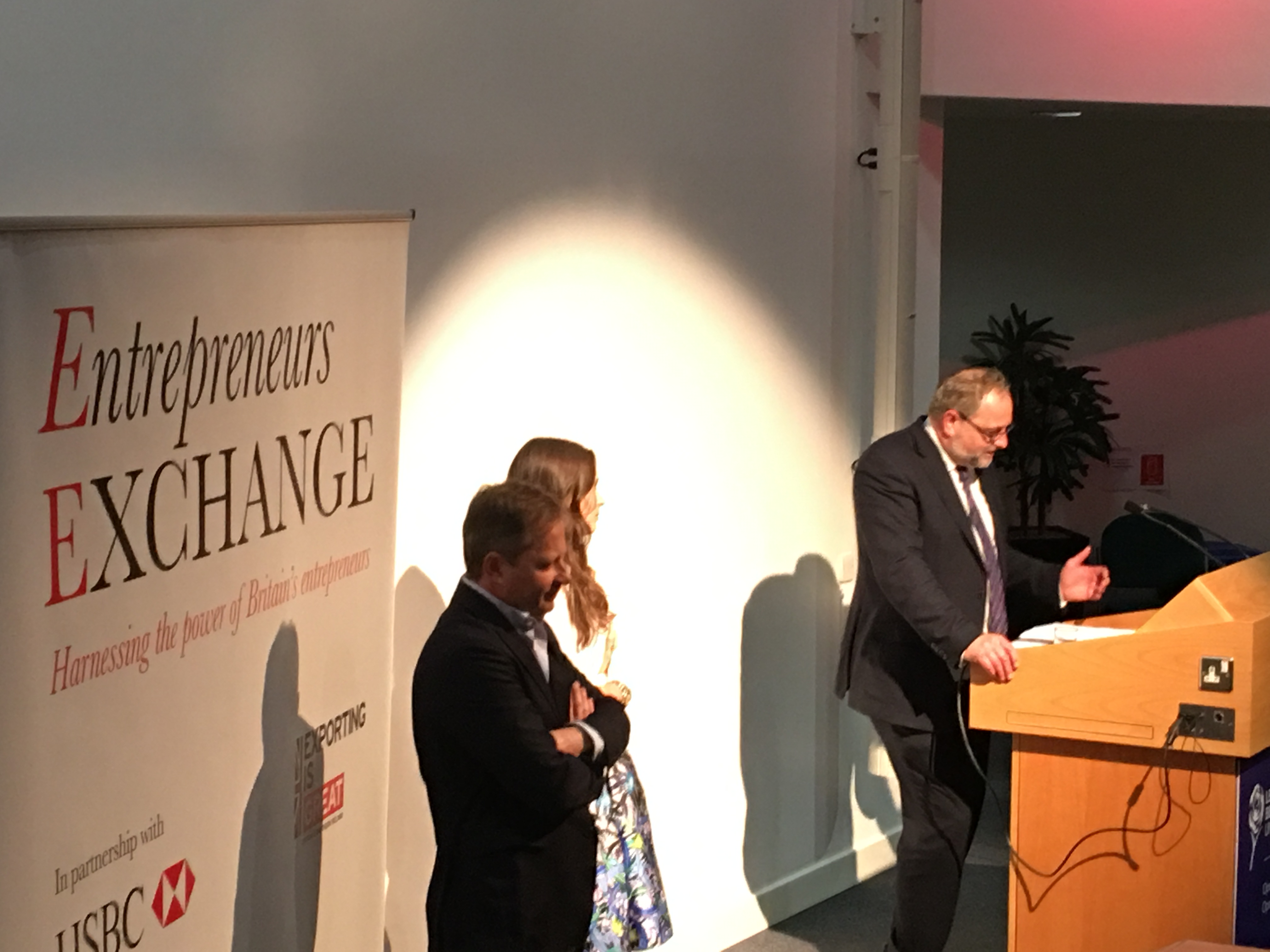
Yorkshire Post UKTI International Business Roundtable

Exporting Yorkshire

Exporting Yorkshire

The need for the right skills dominated a roundtable discussion which I attended at the Yorkshire Post headquarters in Leeds.

A group of Yorkshire businessmen from a diverse range of industries met with Greg Wright, Deputy Business Editor of the Yorkshire Post, for a discussion on International Business, sponsored by UK Trade and Investment.

Alongside the Post’s delegation other people attending the roundtable included Stephen Crow (Business Development Partner at Clarion solicitors), David Wragg (Operations Director of Hargreaves Industrial Services), Mark Parks (Managing Director of Boston Air Group), Colin Russell (UKTI), Jim Hart) CEO at OneGlobal) and Daniel Hughes (Director at Turner & Townsend).

Starting off proceedings, Greg asked questions regarding selling the Yorkshire brand overseas. Do foreign firms buy from you because you are a Yorkshire business? Daniel Hughes, of Turner & Townsend, responded that it wasn’t the fact that the business was Yorkshire-based which decided why customers should buy. However, Daniel went on to state that the region did have positive connotations around the character of the people of the County and their trustworthiness. OneGlobal’s Jim Hart added that being a UK business in terms of USA trade was deemed as a negative, because Americans preferred to buy local.

UKTI advisor Colin Russell added that Indians might know of the “brand” Yorkshire due to the deep roots of cricket. Nonetheless, Colin went on to state that, fundamentally, customers want to know you have the knowledge and skills to deliver a quality service. The Yorkshire brand adds colour to the UK story but it’s ultimately about what you deliver. Mark Parks, founder of Boston Air (a recruitment business focused on the aeronautic industry), went on to say it’s easiest to start exporting British into North West Europe. David Wragg of Hargreaves Industrials went on to state that the Yorkshire accent is notable, and people do ask where the accent is from when you’re abroad.

Greg then challenged the group on the importance of getting the right skills. Daniel responded that the key barriers to doing international business were mobilisation issues. Jim Hart stated the importance of selling in the local language and having a local website presence. When you are trading with a foreign country, you’ve got to be committed to it and localise your products and services.

Exporting Yorkshire

Exporting Yorkshire

Some of the bigger challenges around international business, highlighted by Mark Parks, were deemed to be around the issues of regulation. Another businessman added the importance of understanding the culture of the country and how to deal with people.

Everyone attending the roundtable agreed that service exports, which were once traditionally done by the largest plc companies in the UK, are now being seen by mid-market firms. Quite often, what happens is suppliers follow their clients from one country to another and this is how internationalisation occurs. UKTI suggested the importance of Yorkshire businesses collaborating and learning from each other.

Daniel Hughes went on to reflect on the importance of having the right partners and being very selective when it comes to finding business partners overseas. Once you find the right partners you can then scale up your business.

Greg’s final question was to ask us what tips we would give to other businesses looking to export around the world.

Here’s a few snippets of the best pieces of advice for going International:

  • UKTI advised to go for easiest markets first e.g. North West Europe.
  • Jim Hart – Commit to one market at a time.
  • David Wragg – Go to the top of an organisation when selling abroad and find the right decision makers.
  • Stephen Crow – Make sure you talk to UKTI.

Personally, I think businesses should start small and scale fast. The difference between a good business and a great business is whether it is international. We now live in a global village and, with cheap air travel and the Internet, it has never been a better time to get started.

Connecting knowledge with those who need it…

Research shows that more than 70% of employees use search engines to learn things. They use their smart phones for just-in-time solutions to improve their performance. Of course searching on the web does not give your company’s specific context.

How often do you send an article link or a YouTube video in a email for a colleague to see? What if you could track this across your organisation? What if you could see what other colleagues are searching for? What if all learners became content curators?

We all have a calling in life and quite often this is our vocation. Of course, if you love your work you’re always trying to get better through learning from others. That’s why, over a number of years, we created Promatum. Pro in latin means “In” and Matum means “The Call”. Promatum is a tool that helps you and your peers improve in your given calling.

Promatum provides just-in-time, social learning, to take your organisation’s performance to the next level. We created Promatum in collaboration with Fortune 500 companies to enable a bottom-up approach to learning.

The above diagram demonstrates how new members of staff need the traditional LMS to provide them with induction and compliance training. Once a member of staff is established and competent in their job, less formal learning can be used to drive value.  Promatum can be used to capture the knowledge of the top 20% of your staff and then share this with B-players to turn them into A-players. Perhaps the platform could even help C-players become A-players! Equally, you can share knowledge outside your enterprise within your supply chains or distribution channels using the same technology and generating similar competitive advantage.

Promatum allows you to:

  • Harness devices already in your workplace
  • Capture knowledge on the job
  • Promote contextual learning
  • Deliver “bite-size” learning
  • Promote sharing of knowledge
  • Embed learning within daily routines

What’s unique about mobile devices in a learning context is that most people already check in several times per day, as part of their daily routine, so they’re the perfect vehicle for embedding learning as a day-to-day activity rather than something for training days and other “special occasions”.

The only sustainable competitive advantage is the ability to learn and apply the right stuff faster. Using smartphones to deliver learning has been so effective that participants now take their courses in about 45% less time.
Some of the benefits of Extended Learning Enterprise are:

  1. Quickly update customers and resellers about new product launches, or changes to products (e.g. software)
  2. Track compliance of franchises and other VARs to ensure they are providing the best advice to customers
  3. Reduction in support costs using e-learning
  4. Creating an active community around your product and services
  5. Learning and Development becomes a profit centre as they are able to provide sales training to their VAR

You can learn more about Promatum, a new product by Webanywhere, at www.promatum.com

How teachers can do what technology can’t, BETT 2016

Sean Gilligan with Tom Starkey

Sean Gilligan with Tom Starkey

Having just been at the BETT Show in London Excel, one of the most interesting talks was chaired by Tom Starkey, a teacher and columnist for the Times Educational Supplement. He was joined on stage by guest panelists Miles Berry (principle lecturer for computing education at Roehampton University) and Maurice de Hond (founder of the Steve Jobs School).

The discussion was somewhat controversial subjected on “How teachers can do what technology can’t.” Some in the profession (and this isn’t just limited to education!) fear that computers, robots and indeed artificial intelligence (AI) will replace them. The advent of machine learning and the ever-changing and fast-evolving technology landscape means things like driverless cars are just around the corner, and with the internet of things, people may be less needed. Indeed Miles Berry stated that the chances of a school secretary being replaced by a robot were 65%. However the replacement of a primary school teacher was 9% and a secondary school teacher just 1%.

Miles argued that if robots can do the repetitive, low level tasks, then why not let them? This would then free up teachers to do the more important tasks of teaching and learning. After all, if marking can be automated then why not allow for this and free up more time for lesson planning?

Tom Starkey and Miles Berry BETT 2016

Tom Starkey and Miles Berry BETT 2016

Teachers are needed for helping with creativity and curiosity, as well as building pupils’ character. Teachers are needed and don’t need to worry about their employability. What’s more important is the employability of their students in a digital world. It’s the learning process which is key, and the relationship between the teacher and the learner.

Agile methodology works for software developers, so why not teachers? Students need to be curious, challenge authority and be creative. Teachers should be courageous and set an example to their pupils as role models. Miles suggested that agile software development works in business, so why not therefore apply it to the classroom. Why not let teachers and learners have 10% of their time during the week free to teach what they want to teach, or for learners to learn what they want to learn?

Miles Berry and Tom Starkey taking questions at BETT 2016

Miles Berry and Tom Starkey taking questions at BETT 2016

Our future workforce need to work with computers and robots, not against them. Teachers are not going to be replaced by computers any time soon. Computers and the internet are here for enhancing learning outcomes and transforming education. As Sugata Mitra said in his BETT keynote earlier in the week, “freedom and collaboration are key to creativity.” Knowing “stuff” will be obsolete, because “you plus the device” means you know everything – there’s already evidence that the ability to rapidly look information up on search engines is impacting how we store and remember information.  “I know” is irrelevant. It’s how we apply the knowledge to create new businesses, new ideas and the jobs of the future that’s what’s important. Sugata suggested assessments should be shifted to the employer rather than at the end of school. To establish real change, you would need to change the assessment system in schools.

Below is a short video of the BETT 2016 discussion on “How teachers can do what technology can’t.”

Miles Berry and Tom Starkey at Bett 2016 from Webanywhere on Vimeo.

How to build 21st century businesses of scale in the North of England

This morning it was my pleasure to attend the Yorkshire Post Business Club at AQL in Leeds. The panel included Dr Adam Beaumont the CEO of AQL, Bob Monroe the CFO of Call Credit and Chris Spencer the CEO of EMIS Group. Chairing the Panel was Bernard Ginns, the Business Editor of the Yorkshire Post. All three panelists started by describing their journeys in scaling up tech businesses in the North of England.

Adam Beaumont kicked off the session describing how his business started out life in Leeds. AQL started by offering secure mobile messaging and domain names to customers. They had been trading 16 years and didn’t want to go direct to the customer, instead they wanted to find a partner in order to scale. Adam mentioned how data security as a trusted entity is important to AQL. Originally all the infrastructure and equipment was based in London and the skills were based in Leeds. Adam’s choice was whether to move the skills to London or the infrastructure to Leeds. Luckily for Leeds, AQL chose the North, explaining the living standards are that much better and with excellent Universities on the door step there is lots of potential talent.

Sustainable skills in Leeds is important and Adam sees a skills gap and a potential opportunity in cyber security. Data is becoming more open and more sharable, and we need to safeguard it. In fact the government has just announced it will put £1.9bn into cyber security over the next few years. The links that local colleges provide for new talent will fill this skills gap, and ever increasing challenge in this field.

Bob Monroe then went on to describe some of the history behind his company Call Credit, a credit rating agency spun out of the Skipton Building Society. Bob had spent the last 6 years at Reed Elsevier, running a unit dealing with health data on the south coast, and has now been in place as CFO for the last 7 months.

48M adults have data held by Call Credit, and they describe themselves as a Big Data company. The heritage of Call Credit is that of financial services, but what has been driving the success of Call Credit?

Bob went on to describe how Call Credit had been a troubled teenager. Troublesome to their competitor as they were a disrupter in the market place. Originally Call Credit looked at credit decision making in-house for the Skipton Building Society, but the strong financial players in the Leeds city region allowed the business to spread it’s wings. Their first product was an affordability product, and the offering was then extended so that Call Credit could become a fully fledged credit agency. Software was then put on top of the data, and some of the software was data-agnostic, so would work with other people’s data.

All tech companies need identification software to know who they are dealing with, their age etc. Call Credit is now 2nd in the credit reference agency market and is growing beyond financial services into gaming, eCommerce, retail and other markets.

Bob explained how the difference in age changes people’s views on how happy you are to share data. Older people are still more cautious and tend to have paper shredders at home. Millennials, on the other hand, are much more relaxed in sharing their data.

Consumers need to know how their data is being held and used. £1 can be paid to get your data and find this out, but in the future the consumer will own their data. Call Credit is now a £150M business with 20% growth year on year. The business expects to double in the next 4 to 5 years.

Bob finished by describing what he sees as the three things needed to scale up a business:

  1. Technology: Business must refresh and invest in this
  2. You must be customer focussed
  3. People and culture is crucial

Call Credit have 300 techies and 750 people in their Leeds office. 64% of Call Credit staff are millennia’s and the average age in the company is 34. Call Credit need more data scientists and their Leeds site has the capacity to grow to up to 1,000 full time equivalents.

Third up was Chris Spencer of EMIS Group. Chris was born in Halifax and then moved to Barnsley before going to University in Leeds. Trained as a lawyer, Chris funded his studies as a nurse. It is therefore amusingly appropriate that Chris now leads a successful HealthTech business which started out life in Egton village in North Yorkshire. Two doctors started the business in Egton, thinking it would be a good idea to have an electronic patient record system as they could not read each others handwriting. At the time there was nothing else in the market, and the first product was launched with the name LV otherwise know as Launch Version. Chris was brought in to help build the business up as both doctors wanted to continue practicing in their doctor’s surgeries. The initial vision was to get the software into 50 practices.

Today EMIS software is in 54% of practice covering 5,000 establishments, and the 2nd player in the e-patient records market is TPP also based in Leeds. The software has now gone from the desktop to the cloud with EMIS Web and has expanded it’s reach to be used in pharmacies, A and E units and opticians.

Chris went onto state that people are getting older and are having to live with developing conditions. Cheaper care can be driven by getting the right data out of the systems. EMIS went through a management buy out in 2008 and then went on to be listed on AIM. The share price started at £3, and is now £10.50 giving business a market capitalisation of around £600M. EMIS turns over £150M with a net profit of £30M employing 2,000 members of staff.

Although AIM listed EMIS are proud to use local Northern providers for their legal and financial advise, PR and they are still with the Yorkshire Bank. EMIS are keen to partner with other tech companies in the city region.

The verdict from most of the business people at the breakfast event is that there is a technical skills shortage and that Leeds needs to build it’s brand as a one of the technical hubs for talent in the UK.

Webanywhere my company are encouraging the Iron Yard an American tech company which teaches students how to code to establish a presence in Leeds. Leeds City Council have been very proactive in connecting Daniel Luff of Apollo Eduction Group and the Iron Yard to tech businesses in Leeds. In addition we have steered the American company as to the best locations for setting up their coding bootcamp. I hope that initiatives such as the Iron Yard coupled with more collaboration from the likes of Webanywhere, AQL, EMIS Group and Call Credit will help make Leeds a digital destination for both students and businesses. Leeds can then make a real contribution to building the Northern Powerhouse as part of the new digital economy.