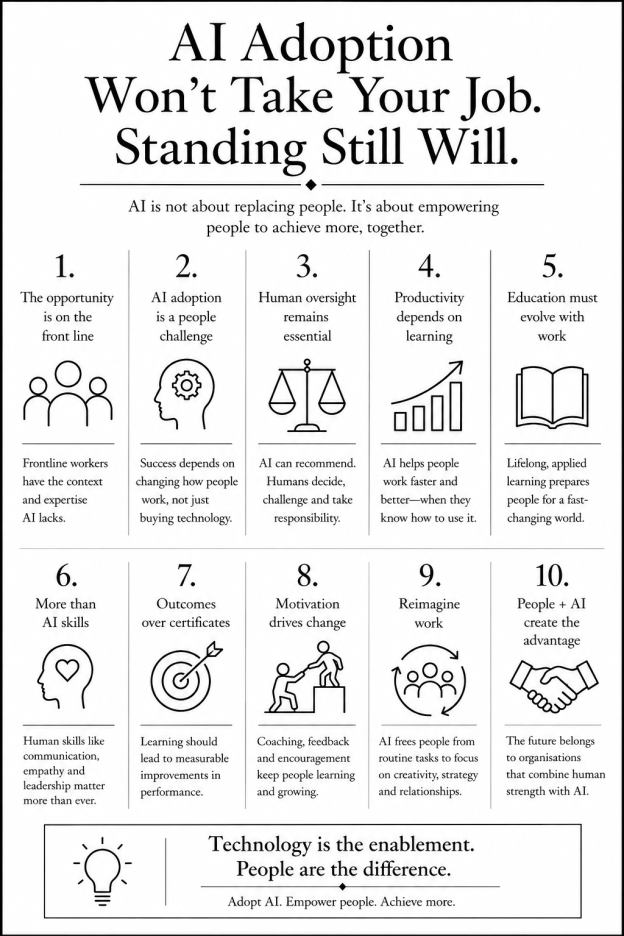
The organisations that succeed in the age of AI won’t be those with the most technology – they’ll be the ones that help their people use it best.
For much of the past decade, the conversation around artificial intelligence has been dominated by fear. Headlines have focused on automation, job losses and machines replacing people. Yet this narrative misses the most important opportunity AI presents. The future is not about replacing human capability; it is about amplifying it.
Artificial intelligence is rapidly becoming one of the most powerful tools ever created, but on its own it delivers very little value. Real transformation happens when AI is placed in the hands of people who understand their work, their customers and their organisations. Technology provides speed, scale and analysis. People provide judgement, experience, empathy and accountability. The competitive advantage lies in combining the strengths of both.
The real opportunity is on the front line
The people best placed to unlock AI’s potential are rarely those sitting furthest from the work. They are the teachers who understand how individual pupils learn, the customer service adviser who knows why complaints escalate, the engineer who recognises subtle problems before sensors detect them, and the healthcare professional whose experience tells them something isn’t quite right.
These frontline workers possess something AI does not: domain expertise and context. They understand the nuances, exceptions and human factors that cannot simply be inferred from data. When these individuals learn to work effectively alongside AI, they become dramatically more productive, more creative and better equipped to solve complex problems.
This is where the greatest opportunity for organisations exists—not simply deploying AI systems, but enabling every employee to use them confidently and responsibly to improve the quality and efficiency of their work.
AI adoption is a people challenge, not a technology challenge
Many organisations still approach AI as though it were another IT project. They purchase software, launch pilots and expect transformation to follow automatically. It rarely does.
Successful AI adoption depends on people changing how they work. Employees need practical experience, confidence and opportunities to experiment safely. They need to understand not just what AI can do, but when to trust it, when to question it and when human judgement must take precedence.
This requires a different approach to learning. Generic awareness sessions and one-off training courses are not enough. People learn best when education is directly connected to the challenges they face every day. AI skills become meaningful only when they help someone write a better proposal, analyse information more effectively, improve customer service or make better decisions.
The goal is not simply to teach people about AI. The goal is to help them become better at their jobs.
Human oversight remains essential
As AI becomes increasingly capable, human responsibility becomes even more important. Organisations must ensure that people remain accountable for decisions, outcomes and ethical standards.
AI can generate recommendations, draft documents and identify patterns at extraordinary speed, but it cannot replace human judgement. It cannot fully understand organisational culture, ethical considerations or the subtle context surrounding many important decisions.
This is why concepts such as human agency and AI oversight are becoming central to responsible AI adoption. Employees must feel empowered to challenge AI outputs, recognise potential errors and apply professional judgement before acting.
The most successful organisations will not remove humans from decision-making—they will equip humans to make better decisions with AI.
Productivity depends on learning
For more than a decade, UK productivity growth has remained stubbornly weak. While organisations continue investing in technology, many have overlooked the single biggest driver of productivity improvement: helping people work differently.
AI offers an opportunity to rethink how work is performed. Routine tasks can be completed faster, information can be analysed more effectively and repetitive administrative work can be significantly reduced. This creates more time for creativity, collaboration, innovation and meaningful customer interaction.
However, these benefits only materialise when people know how to integrate AI into their daily workflows. Technology alone does not improve productivity. Capability does.
Education must evolve alongside work
The implications extend far beyond the workplace. Education itself must evolve if society is to prepare people for an AI-enabled economy.
The UK Government’s increasing focus on technical education, apprenticeships, lifelong learning and workplace skills reflects a growing recognition that careers are changing. Few people entering work today will spend their careers doing exactly the same role. New technologies will continue to reshape industries, requiring people to learn continuously throughout their lives.
Education must therefore become more closely connected to real-world application. Learners need opportunities to solve authentic problems, apply knowledge in practical settings and develop confidence using emerging technologies responsibly.
Equally important is ensuring that educators themselves play a central role in shaping this future. Teachers understand how people learn, how confidence develops and how motivation is sustained. Their insight is invaluable as education adapts to meet the demands of a new industrial era.
The future requires more than AI skills
Technical capability alone will never be enough.
As artificial intelligence becomes more powerful, the uniquely human skills become increasingly valuable. Communication, emotional intelligence, leadership, creativity, collaboration and resilience will distinguish outstanding employees from average ones.
Young people entering the workforce will need to navigate difficult conversations, build relationships, influence others and demonstrate empathy—skills that no AI system can genuinely replicate.
The future belongs to individuals who combine technological confidence with deeply human capabilities.
Learning must drive measurable outcomes
For too long, organisations have measured learning by attendance, course completion and certificates achieved. These metrics reveal very little about whether learning has improved performance.
The future of workplace learning is outcome-driven. Training should lead to measurable improvements in productivity, customer satisfaction, quality, compliance, innovation and business performance.
Employees also need ongoing encouragement. Learning is not a single event but a continuous process. Intelligent coaching, timely feedback and personalised recommendations can help people maintain momentum, build confidence and apply new knowledge in meaningful ways.
Ultimately, organisations should not invest in learning simply to increase knowledge. They should invest in learning that changes behaviour and delivers better results.
Reimagining work for the AI age
Artificial intelligence represents one of the greatest opportunities for economic growth and human advancement in generations. But its success will depend far less on algorithms than on people.
The organisations that thrive will be those that empower their employees to combine human expertise with artificial intelligence. They will encourage experimentation while maintaining oversight. They will invest in lifelong learning rather than one-off training. Most importantly, they will recognise that technology is at its most powerful when it enhances human capability rather than replacing it.
The future of AI adoption is not about choosing between humans and machines. It is about enabling people to achieve more than they ever could alone.
Discover how Learner Journey helps organisations build AI capability, measure AI adoption and deliver real workplace outcomes through applied learning: https://learnerjourney.com