In 1900, the world’s most valuable companies owned railways, steel mills, and oil fields.
A century later, the most valuable companies owned software.
Today, something even more unusual is happening.
The companies most likely to dominate the next century may not be those with the biggest factories, the largest workforces, or even the most sophisticated artificial intelligence. They may simply be the organisations that learn faster than everyone else.
Recently, Microsoft CEO Satya Nadella described what he believes is the defining challenge of the AI era.
He wrote:
“You can offload a task, or even a job, but you can never offload your learning.”
That sentence may turn out to be one of the most important observations about artificial intelligence.
For years, organisations have focused on productivity. How do we automate tasks? How do we reduce effort? How do we do more with less?
AI appears to offer an answer to all of those questions.
But Nadella argues that the real issue is not automation.
It is learning.
Every organisation possesses something invisible.
A school has it.
A university has it.
A hospital has it.
A business has it.
It lives in conversations, meetings, documents, voice notes, presentations, emails, and the accumulated experience of thousands of people.
Most of this knowledge never appears in a database.
It sits quietly inside human beings.
And when those people leave, retire, move on, or simply forget, much of that knowledge disappears with them.
This is where the next generation of learning platforms becomes interesting.
Traditionally, learning management systems were little more than filing cabinets for courses. They stored content and tracked completion.
Useful.
But hardly transformative.
The AI era demands something different.
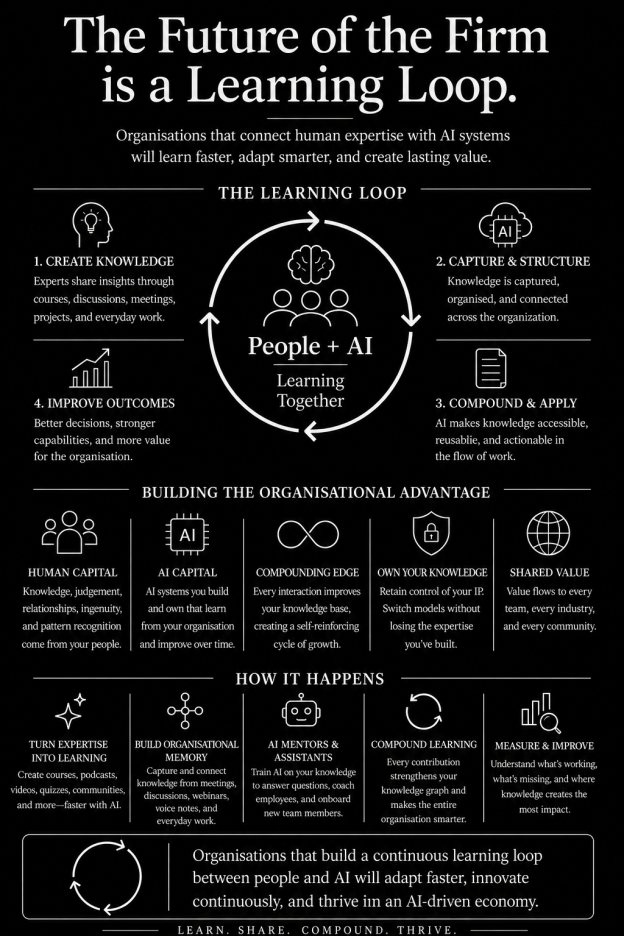
It requires a system capable of capturing expertise, transforming it into knowledge, distributing it across an organisation, and continuously improving that knowledge over time.
That is the idea behind LearnerJourney.com.
At first glance, Learner Journey looks like a modern learning platform.
Users can create learning paths, publish content, generate quizzes, build assessments, issue certificates, create podcasts, videos, and learning experiences.
But underneath those features lies a more significant concept.
Learner Journey is designed to help organisations build what Nadella calls a learning loop.
Imagine an experienced teacher explaining how they support children with dyslexia.
Or a sales manager describing how they handle difficult negotiations.
Or a healthcare professional sharing years of practical experience.
With Learner Journey, that expertise can be captured as a voice note, a document, a video, or a simple prompt.
Artificial intelligence can then transform it into structured learning experiences complete with multimedia content, assessments, AI tutors, podcasts, summaries, transcripts, and personalised learning journeys.
The expertise no longer belongs to one individual.
It becomes part of the organisation.
The next employee learns from it.
The next team builds on it.
The next generation improves it.
And over time, something remarkable happens.
The organisation becomes smarter.
Not because AI replaced people.
But because AI amplified people.
This distinction matters.
Much of the public conversation around AI assumes a competition between humans and machines.
Nadella suggests the opposite.
He describes a future built on two forms of capital.
Human capital.
And token capital.
Human capital is judgment, creativity, relationships, expertise, and experience.
Token capital is the AI capability an organisation develops and owns.
The organisations that succeed will not maximise one at the expense of the other.
They will create systems where both grow together.
That is precisely what platforms like Learner Journey enable.
Every learning path created.
Every question answered.
Every insight shared.
Every expert contribution.
Adds another layer to the organisation’s collective intelligence.
The result is not merely a course library.
It is institutional memory.
It is organisational knowledge.
It is competitive advantage.
The most valuable asset in the AI era may not be a model.
Models will improve. Models will change. Models will be replaced.
The valuable asset is the learning loop that sits on top of those models.
The knowledge unique to your organisation.
The expertise your people have accumulated.
The judgment developed through years of experience.
The patterns that only your organisation can see.
As Nadella argues, companies must retain sovereignty over this knowledge rather than surrendering it to a handful of large AI systems.
The organisations that capture, structure, and compound their learning will possess an advantage that is extraordinarily difficult to copy.
Which raises an intriguing possibility.
Perhaps the future belongs not to the companies with the most AI.
But to the companies that learn most effectively alongside it.
If that proves true, then learning platforms will no longer sit at the edge of the organisation.
They will sit at the centre.
Because in the age of AI, learning is no longer a support function.